If you like any Car and Want to Buy please Call us 24/7

0344-2668711

Want to sale a Car: CLICK HERE

New Printers Vulnerable To Old Languages

When we published our research on network printer security at the beginning of the year, one major point of criticism was that the tested printers models had been quite old. This is a legitimate argument. Most of the evaluated devices had been in use at our university for years and one may raise the question if new printers share the same weaknesses.

35 year old bugs features

The key point here is that we exploited PostScript and PJL interpreters. Both printer languages are ancient, de-facto standards and still supported by almost any laser printer out there. And as it seems, they are not going to disappear anytime soon. Recently, we got the chance to test a $2,799 HP PageWide Color Flow MFP 586 brand-new high-end printer. Like its various predecessors, the device was vulnerable to the following attacks:
  • Capture print jobs of other users if they used PostScript as a printer driver; This is done by first infecting the device with PostScript code
  • Manipulate printouts of other users (overlay graphics, introduce misspellings, etc.) by infecting the device with PostScript malware
  • List, read from and write to files on the printers file system with PostScript as well as PJL functions; limited to certain directories
  • Recover passwords for PostScript and PJL credentials; This is not an attack per se but the implementation makes brute-force rather easy
  • Launch denial of Service attacks of various kinds:

Now exploitable from the web

All attacks can be carried out by anyone who can print, which includes:
Note that the product was tested in the default configuration. To be fair, one has to say that the HP PageWide Color Flow MFP 586 allows strong, Kerberos based user authentication. The permission to print, and therefore to attack the device, can be be limited to certain employees, if configured correctly. The attacks can be easily reproduced using our PRET software. We informed HP's Software Security Response Team (SSRT) in February.

Conclusion: Christian Slater is right

PostScript and PJL based security weaknesses have been present in laser printers for decades. Both languages make no clear distinction between page description and printer control functionality. Using the very same channel for data (to be printed) and code (to control the device) makes printers insecure by design. Manufacturers however are hard to blame. When the languages were invented, printers used to be connected to a computer's parallel or serial port. No one probably thought about taking over a printer from the web (actually the WWW did not even exist, when PostScript was invented back in 1982). So, what to do? Cutting support for established and reliable languages like PostScript from one day to the next would break compatibility with existing printer drivers. As long as we have legacy languages, we need workarounds to mitigate the risks. Otherwise, "The Wolf" like scenarios can get very real in your office…

Read more


  1. Beginner Hacker Tools
  2. Hack Tools Github
  3. Hack Tools Download
  4. Pentest Tools Website
  5. Hacker Tools Online
  6. Pentest Reporting Tools
  7. How To Hack
  8. Pentest Box Tools Download
  9. Nsa Hack Tools Download
  10. Wifi Hacker Tools For Windows
  11. Hacker Tools Apk Download
  12. Hacker Tools Github
  13. Hacker Tools Online
  14. Hack Tools Pc
  15. Pentest Tools Github
  16. Hacker Tools For Pc
  17. Top Pentest Tools
  18. Hacking Tools For Pc
  19. Pentest Tools Website Vulnerability
  20. Pentest Tools For Mac
  21. Hacking Tools Name
  22. Hacker Security Tools
Read more

TLS V1.2 Sigalgs Remote Crash (CVE-2015-0291)


Data Structures


If a bad signature is sent after the renegotiation, the structure will be corrupted, becouse structure pointer:
s->c->shared_sigalgs will be NULL, and the number of algorithms:
s->c->shared_sigalgslen will not be zeroed.
Which will be interpreted as one algorithm to process, but the pointer points to 0x00 address. 


Then tls1_process_sigalgs() will try to process one signature algorithm (becouse of shared_sigalgslen=1) then sigptr will be pointer to c->shared_sigalgs (NULL) and then will try to derreference sigptr->rhash. 


This mean a Segmentation Fault in  tls1_process_sigalgs() function, and called by tls1_set_server_sigalgs() with is called from ssl3_client_hello() as the stack trace shows.


StackTrace

The following code, points sigptr to null and try to read sigptr->rsign, which is assembled as movzbl eax,  byte ptr [0x0+R12] note in register window that R12 is 0x00

Debugger in the crash point.


radare2 static decompiled


The patch fix the vulnerability zeroing the sigalgslen.
Get  David A. Ramos' proof of concept exploit here


Continue reading
Read more

DOWNLOAD SQLI HUNTER V1.2 – SQL INJECTION TOOL

Read more

Difference Between Hacker, Programmer, And Developer

                There are numerous sprite debates and discussions on the differences between hackers, developers, and programmers. With most descriptions, however, there is usually a slight flaw in at least one or two serious ways. These terms are all traditionally misused and misunderstood, with many of us frequently mixing them up as an all-encompassing definition of anyone working on the Software realm.


However, if you are looking to clarify your project goals and business needs adequately, it is essential that you understand that all these terms do not all represent the same thing (although a person with the ability to program a computer can use different skills to accomplish various outcomes).

What's more, it is also quite important for you to differentiate between these three terms if you are working with software development groups and the fact that they cannot be interchanged.  This excerpt seeks to break it all down for you mainly-the vital difference between hackers, developers, and programmers, their actual tasks, as well as their relationship.

The Hacker

A hacker is a computer expert who uses his knowledge of computer networking, programming, cryptography, and databases to overcome a problem in the system. Hackers are more concerned with availing the concept as opposed to minding about the long-term quality. And although a hacker can conceptualize about how will ultimately be created while frantically writing code, the role is primarily about speed.

A hacker, as well as hacking,' are most useful in dealing with emergency circumstances or when prototyping an item. Hackers and the profession of hacking, in general, is not concerned with the ultimate effect of the code.

Hackers make things. They typically alter the things programmers create and transform them to function differently as well as also writing codes. While "hacker" can refer to any skilled technical person, the term has become associated with computer security, someone who, with their technical knowledge, uses bugs or exploits to break into computer systems.

The Programmer

programmer is an individual equipped with the expertise to write codes. Programmers usually master in a single or multiple programming languages and boast vast knowledge on related areas also. Their roles are relatively procedural and mandate for total concentration not to mention refined skills.

A programmer is solely focused both in writing codes as well as getting features appropriately performed so that these features are accessible for integration and later use. Programming is merely the process of swinging the hammer and adequately creating the software.

Usually, it is easy to identify that an individual is in programming mode since they often have a concentrated gaze and are deep in the zone.' Programmers are normally internalizing the system they are operating as well as editing and writing pieces of something that can only best be described as a long algebra problem.'

The Developer

Developers are typically creators. However, not anyone that is an expert at writing codes can be a developer. Developers are experts at identifying ways around various problems as well as plugging together components to fulfill some requirements. These professionals solve problems or create things by adhering to a specific set of principles (design and implementation).

This set of principles includes attributes such as maintainability, performance, robustness, security, and scale among others. They solve problems in a systematic manner. Ideally, this is what distinguishes programmers, developers, and hackers.

In A Nutshell:

In all simplicity, these three professionals solve various problems using code. A programmer is an encompassing term that means a problem solver, a developer is a trained programmer (formal) who besides resolving issues achieves it in an organized and methodical manner likely instilled in the course of their formal education, and a hacker is a tinkerer/creator.

Despite their differences in individual meaning and professional capacities, these terms, however, can interrelate with each other quite effectively. In fact, it is possible for you to combine the skills to your benefit. In reality, all developers and hackers are programmers. However, despite their expertise, not many developers and programmers are creative enough to warrant an identity as hackers.

Finally, although hackers and programmers are quite impressive, they are however not experienced or educated enough to warrant consideration as developers. The similarity, however, is that all work to create code, each in their specified manner.

Ideally, anyone would work to be all the above-as creative as a hacker, though, somewhat better experienced and formally trained to design software as opposed to only hacking.

Nonetheless, even if you lack the creativity, experience, or education, or either to necessarily create a broad application, it is still worth noting that you are still ideally a programmer. And in case you did not know, solving a problem through code is by itself, a superpower!


@£√£RYTHING NT

Related articles


Read more

15 Hidden Android Features You Should Know

While Android has matured by leaps and bounds, it's still going through the refinement phase. Over time, Google has both added and removed many popular features in Android. Sometimes the features are completely removed. However, in many cases, they make it to the Settings page or they are buried under different hidden places inside Android. That's why we have come up with this article where we unearth 15 hidden Android features that are quite interesting and helpful. So, let's go ahead and explore some unique Android features which are available on our Android devices.


Hidden Android Features

Here, we have mentioned several hidden Android features ranging from privacy, security, ease of use and more. Further, we have also added some obscure Android features which were released recently but might have gone under the radar. Now with that said, here are the hidden Android features that you should know and use often.

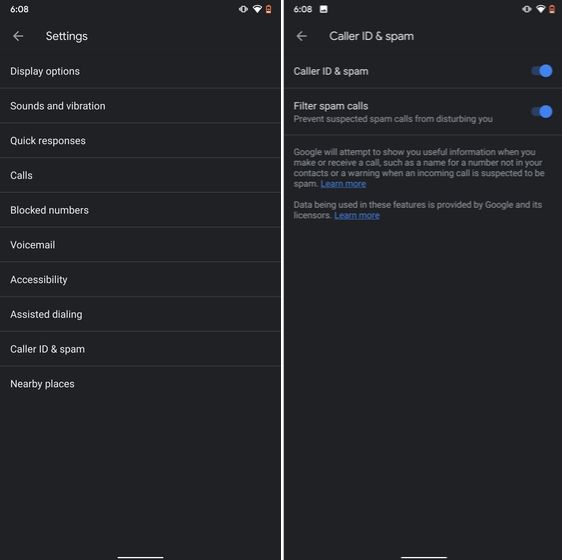
1. Block Spam Calls

The one feature that I turn on whenever I set up a new Android device is: filter spam calls. It saves me from unwanted calls by telemarketers, fraudsters and spammers. If you use a stock Android device, you must have the Phone app by Google installed as your default dialer. To enable spam call blocking, open the Phone app and tap on the three-dot menu on the top-right corner and open Settings. After that, open "Caller ID and spam" and enable both the toggles. Now, whenever you will receive a call by spammers, the screen won't light up or make any sound. It's almost like DND with Total Silence turned on.

1. Block Spam Calls hidden android features

If you are worried that you will miss important calls then fret not. I have been using this feature for a long time and I can vouch that it works flawlessly. While there are other apps like Truecaller with similar features, you should be wary against handing your data to third-party apps, especially given its shady past record.

2. Verification Code Autofill

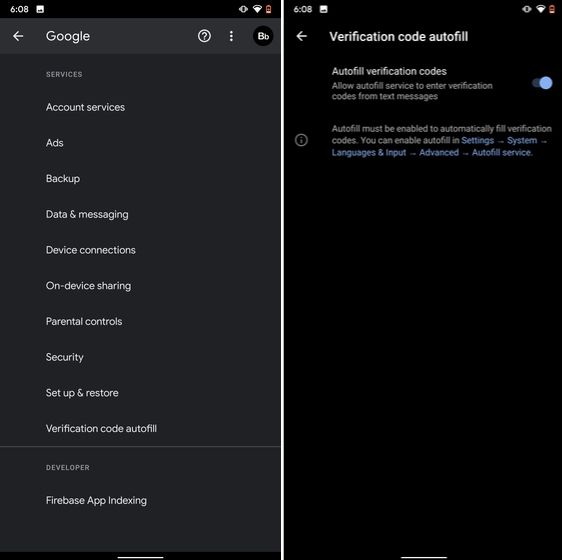
Many of us have allowed SMS permission to multiple apps for seamless OTP verification. However, this can lead to serious breach as apps can read all your text messages and also build credit profile without your consent. To crack down on this behavior, Google has brought a new API called the SMS Retriever. It allows apps to capture a one-time code without asking for SMS permission. In case, the app developer has not implemented this API, Google will act as a bridge and provide the verification code. That is awesome, right? So to enable this feature, navigate to Settings -> Google -> Verification Code Autofill and enable the toggle. Make sure you have also enabled the Autofill service by Google.

2. Verification Code Autofill

3. Force Dark Mode on all Apps

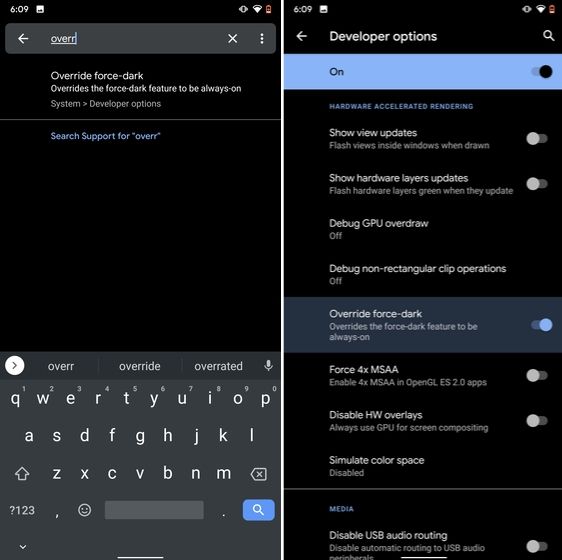
While the dark mode is slowly becoming the norm, there are still apps like Facebook and WhatsApp which are yet to embrace the dark side. If you want to force dark mode on a range of apps then there is a hidden Android setting that lets you do it. However, you must be on the latest Android 10 build. To enable dark mode for all the apps, navigate to Settings -> About Phone and tap on the Build Number for seven times continuously. A toast notification will show up prompting "Developer Options have been enabled". Now go back, and search for "Override force-dark" in the Settings page. Tap on the first result and then enable the toggle. Just to be sure, restart your device and check if dark mode is working on all apps.

3. Force Dark Mode on all Apps

4. Focus Mode

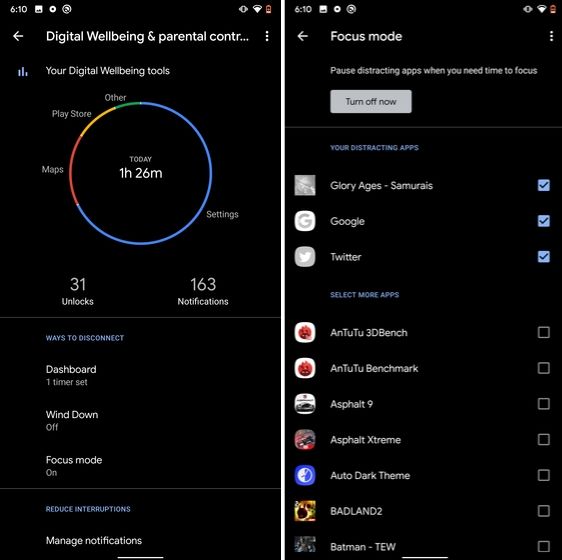
Google has brought a new feature called Focus Mode to Digital Wellbeing with the launch of Android 10. While Digital Wellbeing is great at limiting the screen time of various apps, Focus Mode allows you to block certain apps completely so you can focus on what you are doing. To configure Focus Mode, follow Settings -> Digital Wellbeing -> Focus Mode. Here, you can select apps that you find distracting and can enable Focus Mode straight from the Quick Settings panel.

4. Focus Mode hidden android features

5. Share WiFi with QR Code

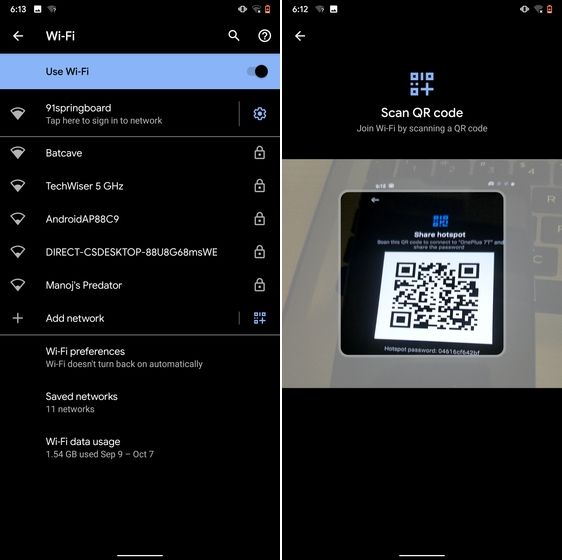
I know the feeling when someone asks you to share your WiFi's password and you can't seem to remember it. If you use a strong password with multiple hashes and characters then it becomes even more tedious to type it out. In such cases, a QR code can help you seamlessly connect to WiFi networks. Thankfully, Android 10 has this not-so-hidden feature under the WiFi Settings page. Open it and you will find the QR code scanner besides the "Add Network" section. Now, scan the QR code and you will be connected in no time.

5. Share WiFi with QR Code

6. Randomize MAC Address

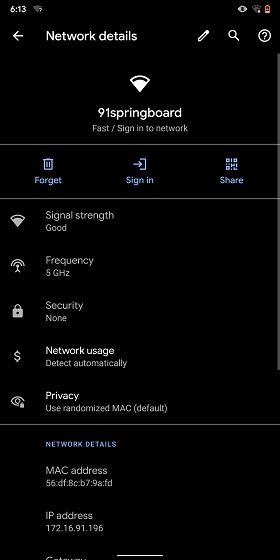
MAC address is a unique identifier assigned to WiFi-enabled devices including smartphones. Most devices come with a static MAC which can be exploited and used for tracking user movement. So having a random MAC address reduces the chance of tracking and strengthens your privacy. If you are running Android 10 then you can randomize the MAC address from the WiFi Settings page. Tap on the WiFi that you are connected to and open "Privacy". Here, make sure "Use randomized MAC" is your default pick.

6. Randomize MAC Address

7. Force Apps to Resize in Split Mode

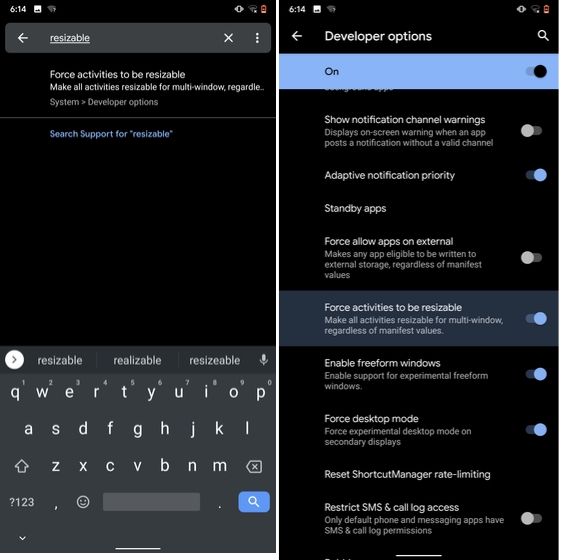
Android has some unique features like Split Mode which make it quite distinct from iOS. It lets you run two apps at once so you can effortlessly multitask between them. However, not all apps support Split Mode and that's where this hidden Android feature comes into play. With this feature, you can force any app to resize in split mode, irrespective of the app compatibility. So to enable this feature, open Settings and search for "resizable". Open the first result and enable "Force activities to be resizable". Now, restart your device and you can enjoy any app in the Split mode.

7. Force Apps to Resize in Split Mode

8. Default USB Configuration

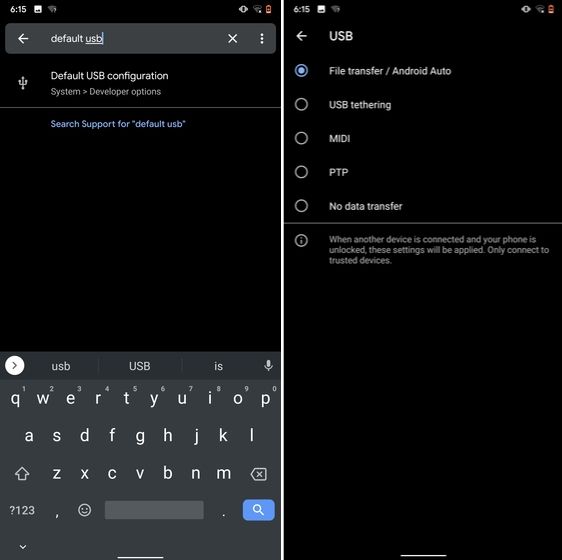
If you are someone who regularly connects Android devices to PC then this sneaky feature is going to help you a lot. Android 10 now allows you to choose your default USB configuration. If you transfer files regularly then simply choose the desired settings and you are good to go. To configure USB, open Settings and search for "Default USB" and tap on the first result. Here, choose "File transfer" or any other settings based on your preference.

8. Default USB Configuration (2) hidden android features

9. Private DNS

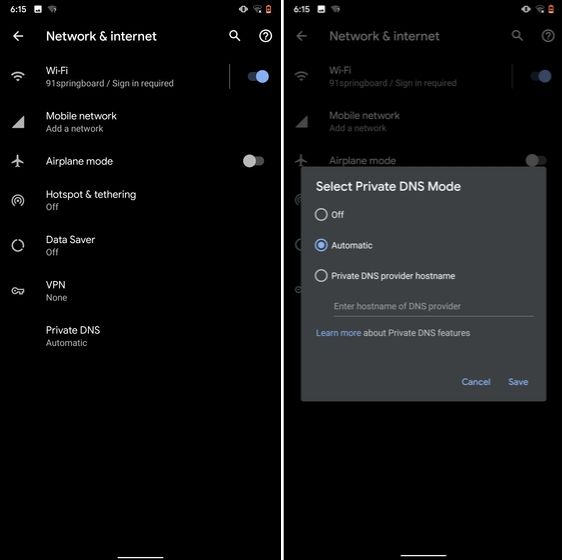
While Private DNS was launched with Android Pie, it still remains one of the least talked features of Android. It allows you to encrypt your DNS query so no one can read it, not even your internet service provider. You can find the Private DNS feature in the "Network and Internet" settings page. Here, open "Private DNS" and choose Automatic for Google's DNS or you can also select some other DNS providers as well. I would recommend you to go with Cloudflare's DNS.

9. Private DNS

10. Device Theming

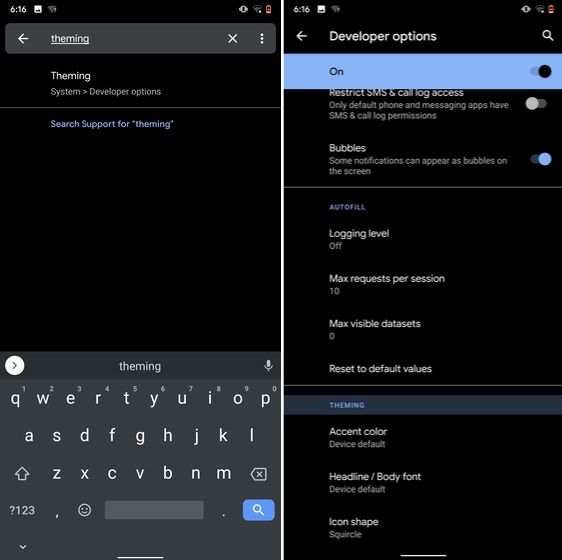
Device theming has finally arrived on Android, but it's still hidden under the developer options. You can change the accent color, font and icon shape from a handful of options. To find the desired settings page, open Settings and search for "theming". Tap on the top result and customize your Android device as you prefer.

10. Device Theming

11. Show Taps While Screen Recording

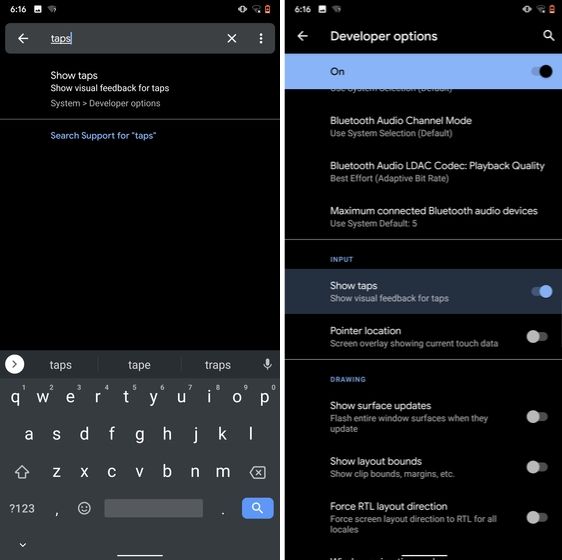
With the release of Android Oreo, Google removed the ability to show taps while screen recording for security reasons. However, the settings to configure taps is still available and hidden under the developer options. Just open the Settings page and search for "taps". Open the first result and enable the toggle. Now, you can record your screen with taps and that's really convenient.

11. Show Taps While Screen Recording hidden android features

12. Capitalize Words Quickly

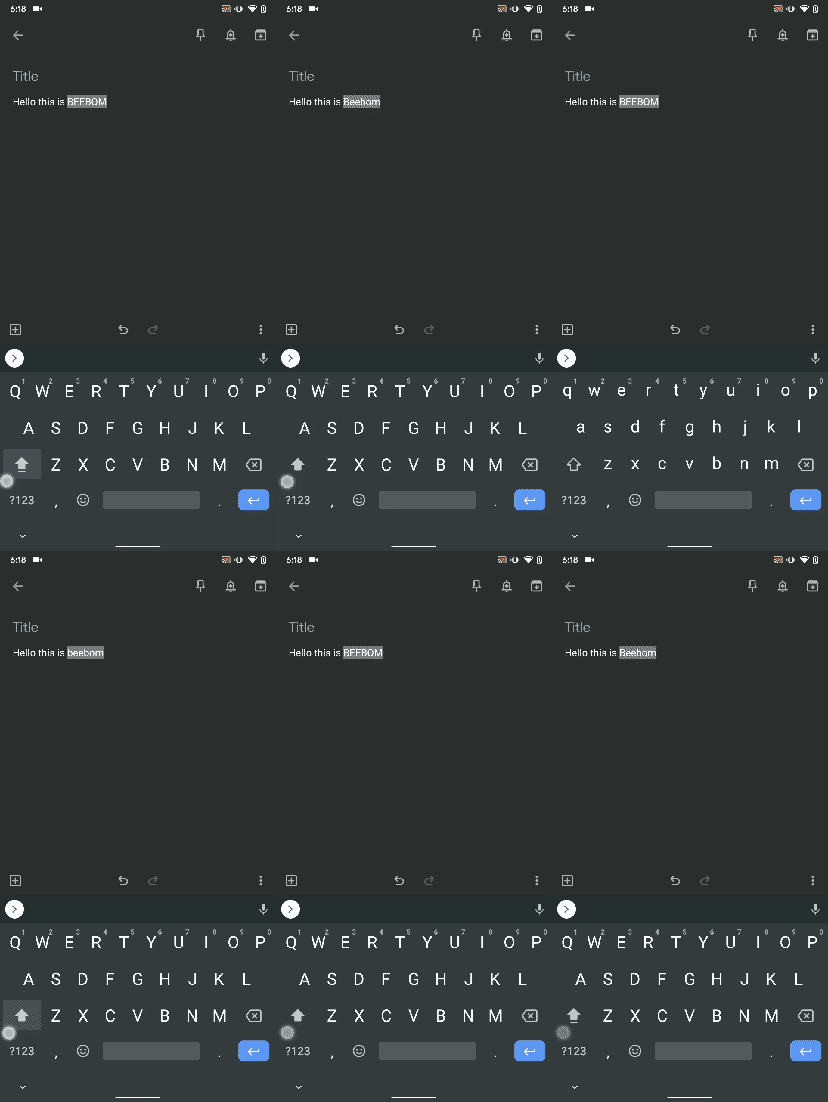
If you want to capitalize words quickly then Gboard has this nifty feature which is super helpful and I simply love it. Just select the words and tap the "Shift" button twice to capitalize a chunk of words at once. You can also make it lowercase by similarly double tapping the shift button. And if you just want to keep the initials capital then tap the shift button once. That's pretty great, right? So go ahead and type hassle-free with Gboard.

Capitalize Words Quickly

13. Uninstall Multiple Apps

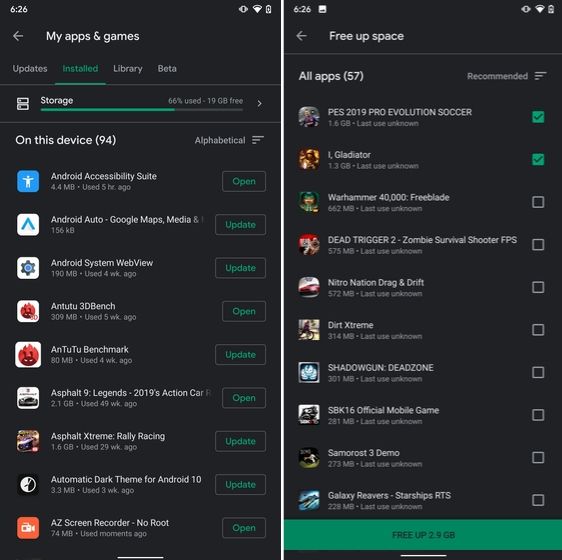
One of the best hidden Android features is that you can uninstall multiple apps at once. It works on older versions of Android as well so that is great. All you have to do is open the Google Play Store and tap on the hamburger menu and select "My apps and games". Here, switch to the "Installed" section and then tap on "Storage". After that, simply select apps that you want to uninstall and hit that "Free Up" button. Voila, multiple apps just got uninstalled in just one tap.

13. Uninstall Multiple Apps

14. Clear Site Storage Using Chrome

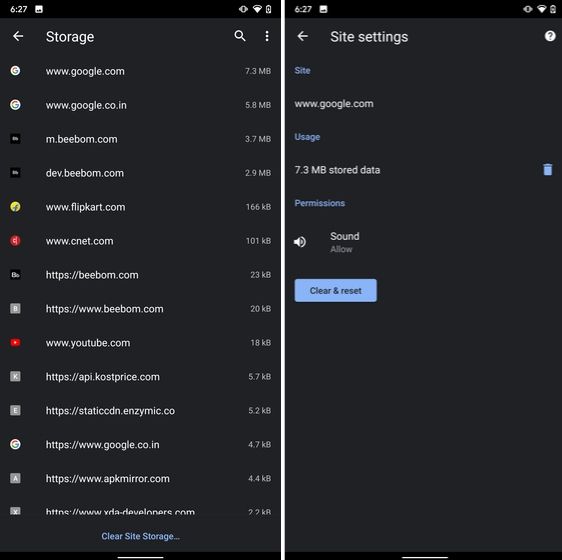
Chrome is notorious for accumulating a large amount of data in background which makes the performance worse and also takes up crucial storage space. If you want to check what websites are eating up your memory space then a hidden Chrome setting can help you with that. Open Chrome on your Android device and head over to its Settings page. Now, navigate to Site Settings and open Storage. Here, you will find all the websites with their storage space. Open any website and tap on the "Delete" icon to finally free up your internal storage from unnecessary cached data.

14. Clear Site Storage Using Chrome

15. Street View Layer in Google Maps

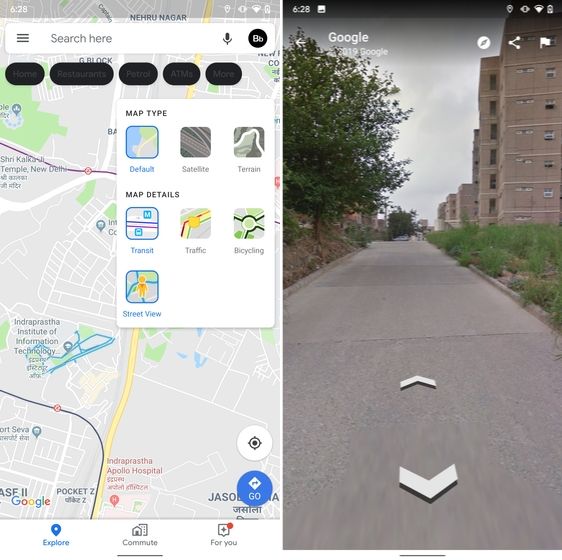
Street View is an immersive way to explore places and find new landmarks, hotels, restaurants from anywhere around the world. Now, the Street View Layer has been added to Google Maps and it works pretty well. To check if Street View is available in your region, open Google Maps and tap on the "layer" icon on the top-right corner. Now, tap on "Street View" icon and then zoom out to find blue lines on the map. Finally, tap on the blue lines and Street View will show up for that place. That's cool, right? So go ahead and check out Street View to find some hidden gems around the world.

15. Street View Layer in Google Maps hidden android features

Note: The blue lines show up wherever street view is available.

@EVERYTHING NT

More articles

  1. Usb Pentest Tools
  2. Nsa Hacker Tools
  3. Hacking Tools 2020
  4. Ethical Hacker Tools
  5. Pentest Tools Online
  6. Hacker Tools For Mac
  7. Pentest Tools Kali Linux
  8. Pentest Tools Free
  9. Black Hat Hacker Tools
  10. Usb Pentest Tools
  11. Hacking Tools Kit
  12. Nsa Hack Tools Download
  13. Pentest Tools Kali Linux
  14. Hacker Tools 2020
  15. Hack Tool Apk
  16. Beginner Hacker Tools
  17. Hacker
  18. Hack Tools Pc
  19. Pentest Tools For Windows
  20. Hacks And Tools
Read more

OWASP ZAP RELEASES V2.8.0 WITH THE HEADS UP DISPLAY

OWASP ZAP RELEASES V2.8.0 WITH THE HEADS UP DISPLAY
Heads Up Display simplifies and improves vulnerability testing for developers

London, England, 20 June 2019. OWASP™ ZAP (Open Web Application Security Project™  Zed Attack Proxy) has released a new version of its leading ZAP Project which now includes an innovative Heads Up Display (HUD) bringing security information and functionality right into the browser. Now software developers can interactively test the reliability and security of their applications in real time while controlling a wide variety of features designed to test the quality of their software.

ZAP is a free, easy to use integrated penetration testing tool. With the addition of the Heads Up Display, ZAP can be used by security professionals and developers of all skill levels to quickly and more easily find security vulnerabilities in their applications. Given the unique and integrated design of the Heads Up Display, developers and functional testers who might be new to security testing will find ZAP an indispensable tool to build secure software.

The latest version of ZAP can be downloaded from 
https://www.owasp.org/index.php/ZAP  The full release notes are available at https://github.com/zaproxy/zap-core-help/wiki/HelpReleases2_8_0.

In addition to being the most popular free and open source security tools available, ZAP is also one of the most active with hundreds of volunteers around the globe continually improving and enhancing its features. ZAP provides automated scanners as well as a set of tools that allows new users and security professionals to manually identify security vulnerabilities. ZAP has also been translated into over 25 languages including French, Italian, Dutch, Turkish and Chinese. 

Simon Bennetts, OWASP ZAP Project Leader commented: "This is a really important release for the project team and developers who want to build great and secure applications. The HUD is a completely new interface for ZAP and one that is unique in the industry. It shows that open source projects continue to create high-quality, new and exciting tools that deliver real value to the market - and at no cost to users." 

"ZAP is the Foundation's most popular software tool," said Mike McCamon interim executive director of the OWASP Foundation. McCamon continued, "For nearly two decades OWASP continues to be a great destination for innovators to host, develop, and release software that will secure the web. Simon and the entire ZAP community deserves great recognition for their continued devotion to open source excellence."

For further information please contact:
Simon Bennetts, OWASP ZAP Project Leader: simon.bennetts@owasp.org  or Mike McCamon, Interim Executive Director, mike.mccamon@owasp.com

More articles


  1. Hacking Tools For Beginners
  2. Tools Used For Hacking
  3. Hacker Tools Online
  4. Hack Tools Online
  5. Hacker Tools For Pc
  6. New Hacker Tools
  7. Hacker Tools For Windows
  8. Pentest Tools For Android
  9. Hacker Tools 2020
  10. Beginner Hacker Tools
  11. Android Hack Tools Github
  12. Pentest Tools Nmap
  13. Hacker Tools Apk Download
  14. Hack Tools Online
  15. Pentest Tools For Android
  16. Hack Tool Apk No Root
  17. Hacking Tools 2020
  18. Pentest Tools For Ubuntu
  19. Beginner Hacker Tools
  20. Best Hacking Tools 2020
  21. Hacking Tools For Kali Linux
Read more

Networking | Switching And Routing | Tutorial 3 | 2018


Welcome to my 3rd new tutorial of networking (Routing and Switching). In this blog you will able to watch an interesting video about basic device navigation such as changing device (router or switch) name, configuration of login password, configuring a device information, router IP addresses and many more.

What is router?

Router is a network layer device which is the 3rd layer in the OSI model which is used to communicate different networks. It is an intelligent device fixed at the boundary of network that connects to other networks and responsible for end to end delivery of the packet that requires an IP address which is known as the logical address which is the basic identity of the device just like our identity card number or roll number and so on, for the identification of source and destination devices. Router is the gateway of the network having two interfaces such as inbound and the outbound interface through which the traffic comes in from different networks and comes out traffic to the different networks.

What is an IP address?

Internet protocol (IP) address is a numeric label given to each and every device in the network for the identification of the device just like our roll numbers in collages, universities which identity each and every student uniquely everywhere. So same concept here, it is a logical address which is used whenever the device want to communicate outside the network that means to another network.

What is Switch?

Switch is basically layer 2 device, which is used to connect two or more than two devices with each other in the same network. It is an intelligent device which doesn't allow the broadcast. It requires Media access control (MAC) address to communicate within the network. Now let's move to the video for further.